
.png)
potential FUNDING
& SIMILAR PROJECTS

Large transportation crossings in the United States are rarely paid for entirely with state tax dollars. Most modern bridge and tunnel projects are financed through a combination of federal loans, private investment, revenue bonds, and toll-backed financing, with only limited direct state funding. This model allows major infrastructure to be built while minimizing the burden on local taxpayers.
A proposed crossing connecting I-95 in Bridgeport, Connecticut to the Sunken Meadow Parkway on Long Island would likely follow the same structure used by other multi-billion-dollar projects across the country.
How the Freedom Crossing Gets Funded
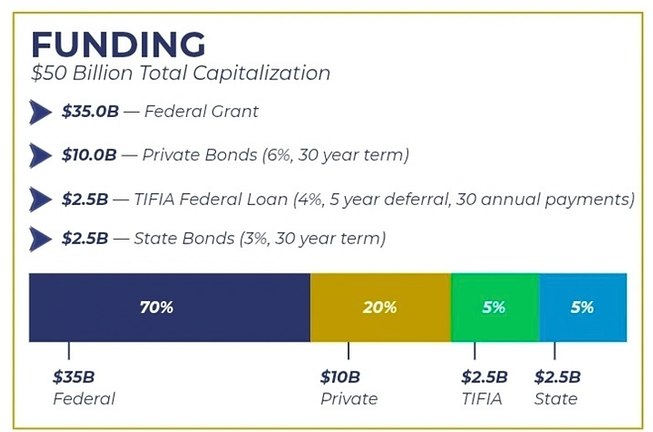
The Freedom Crossing is a $50 billion project. Most of the funding, $35 billion, comes from a federal grant. The rest is made up of $10 billion in private bonds, a $2.5 billion federal TIFIA loan, and $2.5 billion in state bonds. Once the crossing is open, revenue from tolls and rail goes back into the region, supporting environmental programs and new opportunities in Bridgeport and on Long Island.
How Similar U.S. Projects Were Funded

SOURCE: VIRGINIA.ORG
-
Original crossing opened in 1964 using toll revenue bonds
-
Modern tunnel expansion cost about $756 million
-
Funding included:
-
$338.5M federal TIFIA loan
-
$321M bonds
-
Toll revenue pledge
-
Local contributions
-
-
Loan repaid over decades using tolls
This project demonstrates that long water crossings can be built with toll-backed financing and federal loans, not general tax increases.

Gateway Hudson Tunnel Project (NY–NJ)
-
Total cost over $16 billion
-
Federal government covering roughly 70%
-
Remaining funding from local partners and financing programs
Large rail tunnels frequently rely heavily on federal infrastructure funding and long-term financing, not local taxpayers alone.
SOURCE: GATEWAY DEVELOPMENT COMMISSION

SOURCE: HDRINC.COM
Mario Cuomo (Tappan Zee) Bridge – New York
-
Cost about $3.98 billion
-
Financing included:
-
$1.6B TIFIA loan
-
$3B toll-supported revenue bonds
-
-
State capital funds
-
Bonds repaid through toll revenue
This is a clear example of a modern bridge funded primarily through loans and tolls, not tax increases.
CONNECTING COMMUNITIES,
BUILDING THE FUTURE
Across the country, major crossings have become lasting engines for their regions. Bay Area bridges help power regional transit, New York's Thruway bridges support the next generation of infrastructure, and the Chesapeake Bay Bridge–Tunnel has connected communities and commerce for more than 60 years. The Freedom Crossing will join that tradition as a long-term asset for Connecticut and New York.
Once open, the crossing will keep giving back to the communities it connects, supporting environmental programs and creating new opportunities in Bridgeport and on Long Island. The Freedom Crossing isn't just a way across the Sound. It's an investment in jobs, growth, and opportunity for generations to come.